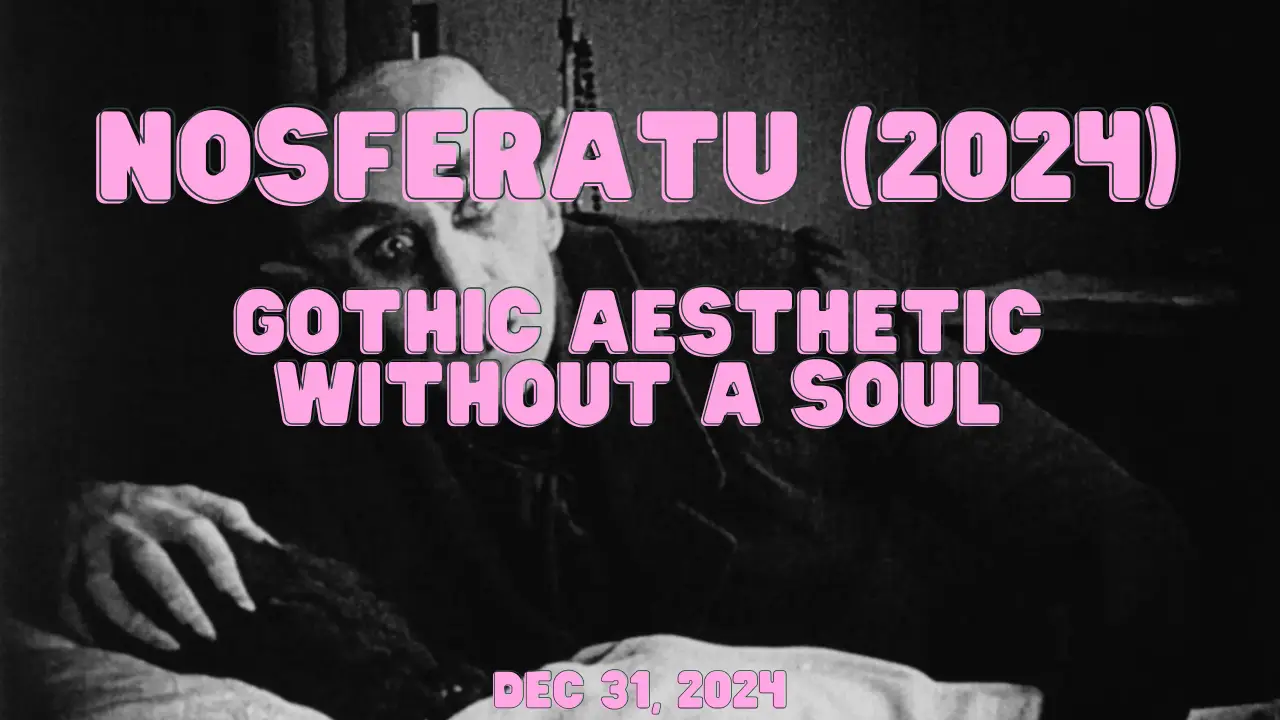

Robert Eggers is a director who revels in the arcane. From the stark puritanical dread of The Witch to the swirling madness of The Lighthouse, his films drip with atmosphere and unrelenting tension. His work is tactile and timeless, full of meticulously crafted details that evoke otherworldly dread. Naturally, his take on Nosferatu, the foundational vampire myth, carried immense promise. Who better to excavate this gothic cornerstone and breathe new life into it?
But Nosferatu (2024) is not the triumph many had hoped for. While visually arresting in moments, the film stumbles under the weight of its reverence for the original. Eggers crafts a gorgeous yet hollow rendition that relies too heavily on its aesthetic, offers little innovation, and, most damningly, fails to connect on an emotional or intellectual level.
Much has been made of Nosferatu’s critical acclaim, particularly among progressive Letterboxd users who praise its artistry and thematic ambition. Yet my own experience couldn’t have been further removed from this enthusiastic consensus. As the credits rolled, the audible groans from my theater companions told a different story: “That was lame.” “That was boring.” “That was weird.” This dissonance—between critics who champion the film and audiences who seem overwhelmingly underwhelmed—is impossible to ignore. Where critics see art, many viewers see artifice, and Nosferatu’s inability to bridge this gap is emblematic of its broader failures.
The film’s treatment of sexuality offers another layer of critique. Within the first few minutes, we’re introduced to Lily-Rose Depp’s Ellen in a moment of soft, vulnerable ecstasy, orgasming softly while an invisible specter overtakes her. What might have been a subversive or haunting depiction is immediately cheapened by a hackneyed jump scare, reducing the scene to a hollow shock. The larger implications are no better. The film equates female sexuality with corruption and plague, leaning heavily on outdated tropes that paint desire as a kind of contamination. This framing is not only reductive but tiresome, a relic of horror’s past that feels out of place in a genre that has largely moved beyond such simplistic metaphors. Instead of using sexuality to explore power dynamics, fear, or vulnerability, Nosferatu relegates it to a tired moralistic device.
The broader structural issues compound these thematic shortcomings. Eggers is no stranger to slow, deliberate pacing, but here, the problem isn’t the length of individual scenes—it’s their purpose. Time and again, I found myself asking, “Was that necessary? Did this push the narrative forward?” More often than not, the answer was no. The subplot involving Ellen’s stay with another family is a prime offender, consuming nearly 45 minutes of screen time while contributing nothing meaningful to the central story. Remove it entirely, and the narrative remains unchanged—a glaring example of indulgence for its own sake.
The film’s overreliance on its source material exacerbates this issue. Rather than reimagining or modernizing Nosferatu, Eggers seems content to meticulously preserve its structure, adding little beyond a fresh coat of gothic paint. But classics endure because they are singular, irreplaceable. Attempts to remix them often feel redundant, and Nosferatu is no exception. It’s like reimagining a Michael Jackson song; the original casts too long a shadow, leaving the remake to feel like an afterthought.
Visually, the film is undeniably striking, at least initially. Eggers leans heavily on shadows and stark contrasts, crafting a chiaroscuro aesthetic that recalls the expressionist roots of the original. Yet this visual language quickly grows monotonous, with shadows bleeding into each other until the screen feels oppressively flat. What begins as an artistic triumph devolves into a stylistic crutch, smothering the film’s emotional and narrative depth.
Count Orlok himself suffers from a similar lack of restraint. Horror thrives on what is unseen, on the implied and the ambiguous. But in Nosferatu, Orlok is shown far too often, his grotesque visage lingering in the frame until all menace is drained away. By the time he’s seen for the umpteenth time, he’s no longer a chilling specter but a grotesque fixture, overexposed and demystified.
And yet, despite these glaring flaws, Nosferatu continues to garner praise from critics who laud its ambition and artistry. This disconnect between progressive Letterboxd enthusiasts and general audiences is striking. The former seem to find meaning in its aesthetic flourishes and thematic pretensions, while the latter, myself included, are left cold by its lack of emotional resonance. It’s a film that demands admiration but offers little in return—a work designed to be studied rather than felt.
Ultimately, Nosferatu (2024) is a missed opportunity. Eggers has proven himself a filmmaker capable of weaving atmosphere and narrative into unforgettable cinematic experiences. Here, however, his talents are squandered on a project that feels more like an homage than a reinvention. Instead of reanimating a classic, Eggers delivers something lifeless—a shadow of what it could have been. For all its ambition, Nosferatu left me unmoved, a film that, much like its titular vampire, fails to cast a reflection.
Leave a Reply